Original vs fake charger: 7 checks before you plug in
A fake charger can look perfect and still fail basic safety tests. These 7 checks help you tell an original from a copy, and here is what to do if you already own one.
A fake charger rarely looks fake. It carries the logo, the model number and even the safety marks, and it does charge your phone, only slowly. The danger is inside, in the insulation between mains power and the USB side you touch. So, original charger kaise pehchanein? Below are 7 checks you can do in a shop or at your door before anything goes into the socket, what a genuine charger does once plugged in, and what to do if you already own a fake.
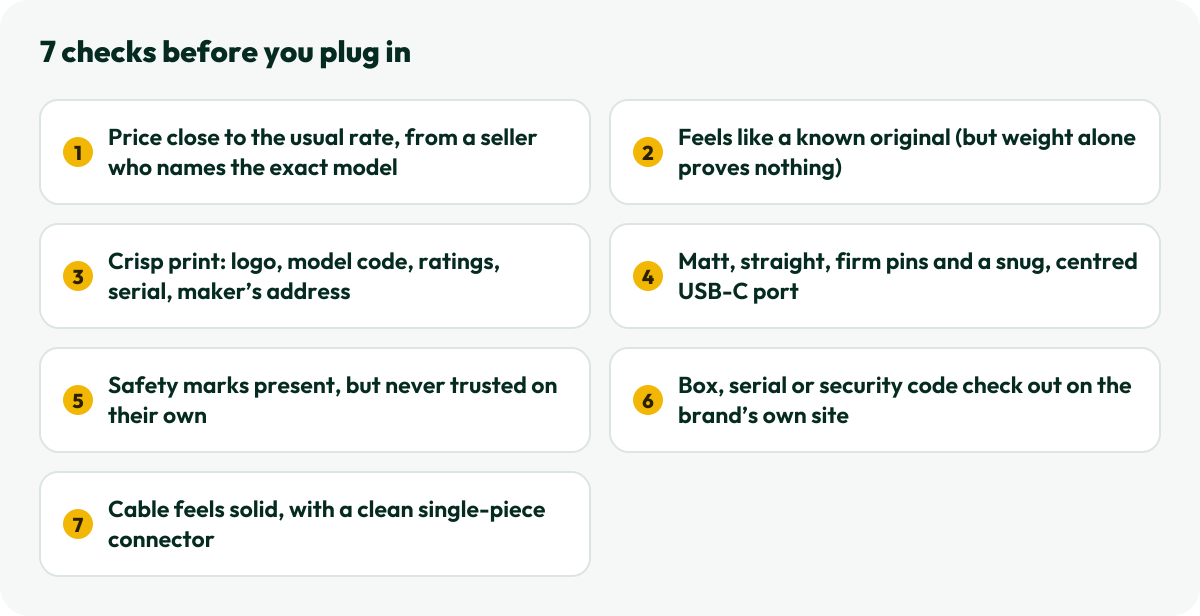
Screenshot this list for your next charger or cable purchase.
Why a fake charger is dangerous, not just slow
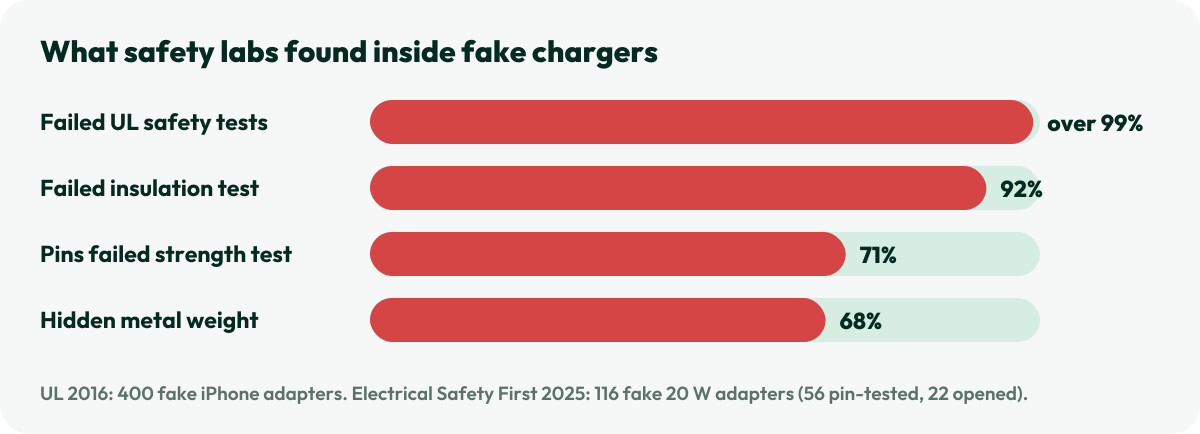
A charger’s main safety job is to keep mains electricity away from the low-voltage USB side. Counterfeits cut corners exactly there:
In an investigation published in 2016, UL tested 400 counterfeit iPhone adapters collected in eight countries. All but three failed its basic safety tests, twelve posed a risk of lethal electrocution, and they carried UL marks they had no right to use.
Apple warns that adapters which don’t meet safety standards could put users at risk of injury or worse. Samsung says that with a counterfeit you lose access to Samsung’s services and will struggle to get compensation for any damage.
Fakes fail where you can’t see: insulation, pins and what’s hidden inside.
The 7 checks before you buy
1. Price and the seller
An original brand charger has a fairly steady market price. If one listing is far cheaper than every other seller, ask why. Be just as careful with listings that shout “100% original”: Electrical Safety First points out that genuine sellers rarely need to overstate authenticity. Buy from the brand, its authorised sellers or a shop that names the exact model and gives you an invoice.
2. Weight, with a twist
Real chargers feel dense because of their transformer, components and insulation, and many fakes feel light. Counterfeiters have caught on, though: of 22 fakes Electrical Safety First opened up, 68% had metal weights hidden inside, sometimes a quarter of the charger’s weight, and that metal undermined the separation between mains and USB. A light charger is a red flag; the “right” weight proves nothing. Compare it with a known original if you can.
3. Print and label
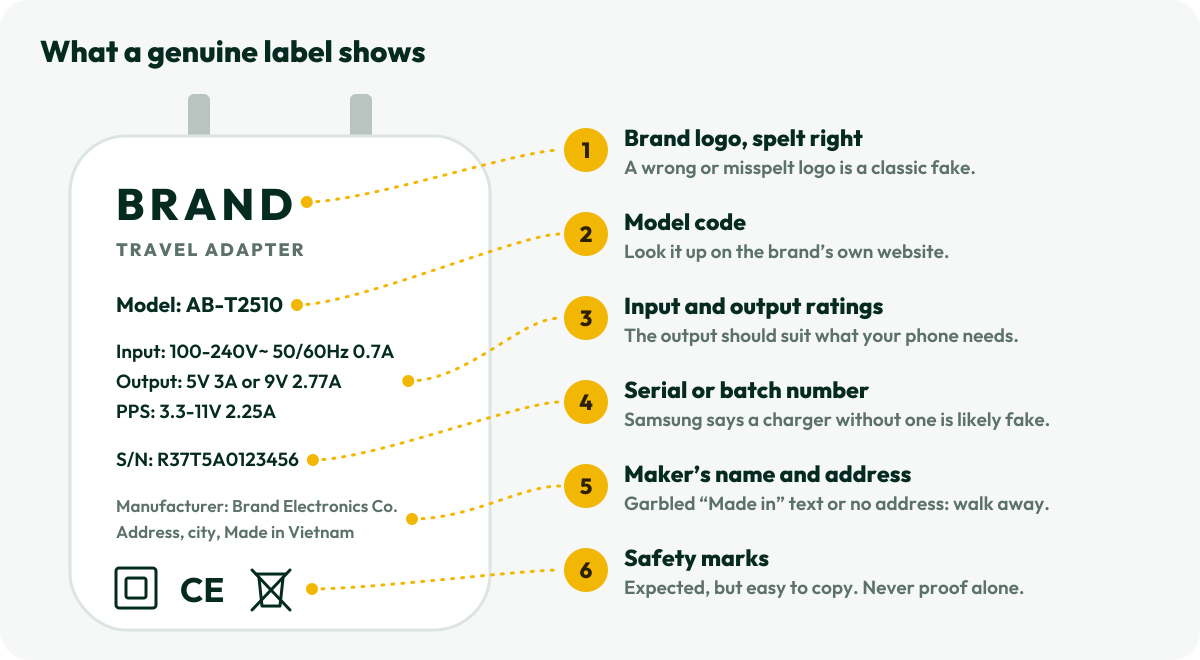
Genuine printing is crisp, straight and correctly spelt. Samsung’s list of counterfeit tells includes a misspelt country of manufacture, words run together such as “TRAVELADAPTER”, a missing manufacturer address, stray extra text and the wrong logo. Samsung Canada adds that a genuine Samsung charger normally shows the Samsung logo, the words “TRAVEL ADAPTER”, a serial number and a model code.
Every line on a genuine label has a job. Missing or garbled lines are your first clue.
4. Pins, port and plug
Look closely at the pins. Electrical Safety First found that genuine pins have a matt, even finish while fakes are often glossy with surface flaws, and 71% of the 56 UK fakes it tested failed a pin-strength test. Some snapped, which can leave a pin stuck in the socket. The pins should be straight and firm, the USB-C port centred and snug, and the input range printed clearly; UL notes that a genuine Apple adapter accepts anything from 100 to 240 V.
5. Safety and certification marks
CE, UKCA, UL and similar marks should be there, but Electrical Safety First warns they can be faked, and UL’s 400 counterfeits carried copied UL marks. Treat a missing mark as a warning and a present one as proof of nothing. For cables, USB-IF certified USB-C cables carry a 60W or 240W logo, and certified Lightning accessories show Apple’s MFi badge on the box.
6. Packaging, serial and brand verification
Originals come in sharp, well-printed boxes whose model code matches the charger. Some brands let you check online: Anker prints a 16- or 20-digit security code on many of its boxes that you can verify on its site, though it says a missing code doesn’t automatically mean a fake. Apple prints “Designed by Apple in California”, the assembly country and a 12-digit serial on its Lightning cables, about 18 cm from the USB end. Type the brand’s web address yourself rather than scanning a QR code on the box, since a fake box can send you anywhere.
7. Cable thickness and the connector
A fast-charging cable carries several amps, so it needs proper copper, and anything above 60 W needs a 5 A rating with an e-marker chip. A “100 W” cable as thin as an earphone wire is suspect. Apple’s guide to counterfeit Lightning cables lists tells you can see: a connector made of more than one piece, squared or uneven contacts, and a boot that varies in size instead of a consistent 7.7 mm by 12 mm.
The plug-in test: what a genuine charger does
It fast-charges. A matching original triggers your phone’s fast-charging message; Samsung phones, for instance, show “Super fast charging 2.0” with Samsung’s 45 W charger and 5 A cable. Plain “Charging”? Check the phone’s fast-charging setting first, then suspect the charger or cable.
It gets warm, not hot. Warmth under load is normal. Burn marks, buzzing or crackling, or a charger too hot to hold mean unplug it at once.
It isn’t left alone. Electrical Safety First advises against charging overnight or while you’re out of the house, whatever the charger.
Original vs fake at a glance
Check
Original
Likely fake
Price
Close to the usual market price
Far below every other seller
Weight
Dense and solid
Light, or oddly heavy for its size
Print
Crisp, correct spelling, model code and serial
Blurry, typos, words run together
Pins
Matt, straight and firm
Glossy, rough or loose
Safety marks
Present, but not proof on their own
Missing or copied
On your phone
Fast-charging message appears
Plain “Charging”, gets hot
Cable
Solid feel, single-piece connector
Thin, loose, multi-piece connector
Already bought a fake? Here’s what to do
Stop using it, even as a bedside spare.
Don’t sell it or give it away. It is just as dangerous for the next person.
Go back to the seller with your invoice and ask for a refund or a genuine replacement.
Check your phone and cable for scorch marks or a loose port. If anything looks wrong, visit the brand’s service centre, and expect questions if a counterfeit was involved.
Recycle it as e-waste, not with household rubbish.
Frequently asked questions
Original charger kaise pehchanein in one minute?
Check the print (logo, model code, serial, no typos), the pins (matt and firm) and the price. Then plug it in: an original that matches your phone triggers fast charging.
Is a “master copy” charger fine if it works?
No. “Works” only means it delivers power. The lab tests above show that most counterfeits fail on insulation, which you can’t see from outside.
Is a third-party brand the same as a fake?
No. A fake pretends to be another brand. Apple says third-party adapters that meet safety standards can be used with iPhone, while Samsung recommends its own chargers for Galaxy phones.
Does a fake cable matter if the charger is original?
Yes. A poor cable can block fast charging, and Apple notes counterfeit Lightning cables can get very hot or even damage your device.
Found this useful? Share it with someone who’s buying a phone.
Mobile Sahab is the voice of MobileSahab, an online phone store in Lahore that sells new, box-packed, PTA-approved phones, PTA-approved used phones and genuine accessories. Our guides come from what we check every day before dispatch: IMEIs on PTA’s DIRBS system, seals and warranty cards, and chargers and cables we test ourselves.
Most phone scams follow the same script, and a few checks break it. Here is when advance payment is fine, how to verify any seller, and what to do if your money goes to the wrong person.
Three phones can look identical and still behave very differently on a Pakistani SIM. Here is what PTA approved, non-PTA and patched really mean, and which one is worth your money.

Questions and comments
Ask Mobile Sahab, or tell other readers what worked for you.