Fast charging explained: PD, PPS, SuperVOOC and the right charger for your phone
A 65 W charger can still charge your phone at a crawl. Here is how PD, PPS and the brand systems really work, and which charger and cable your phone needs.
Mobile Sahab · 7 min read
Bought a big 65 W charger and your phone still says plain “Charging”? Fast charging only happens when the charger, the cable and the phone speak the same language, and today there are several: USB Power Delivery (PD), its PPS mode, and each brand’s own system. Here is the plain-English version, with every brand claim checked against the brand’s official pages, and a table that tells you which charger to buy. Sahi charger, sahi speed.
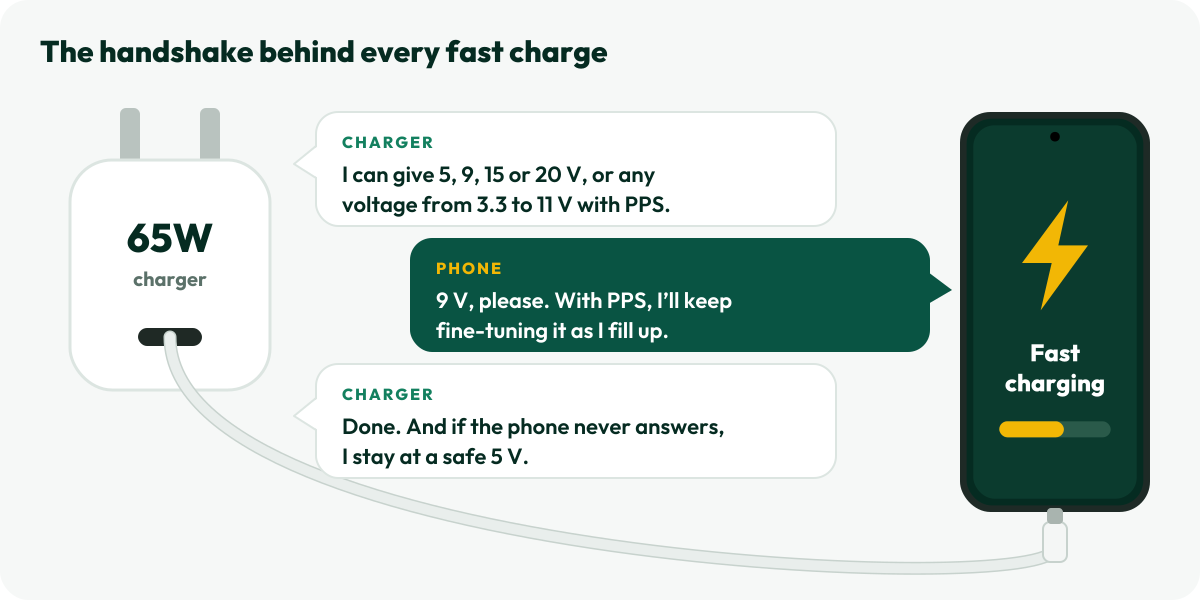
Every fast charge starts with this short conversation. No agreement means normal 5 V charging, not damage.
How fast charging works: the handshake
A basic USB port supplies 5 volts. To charge faster, the charger has to raise the voltage, the current or both, and it only does that after a quick digital conversation with the phone. In USB PD, the charger lists what it can supply, the phone requests one option and the charger switches to it.
Electrical Safety First, the UK safety charity, explains that if this digital handshake fails, the charger falls back to the standard 5 V. That is why a mismatched charger is slow rather than dangerous, as long as it is a genuine one.
USB PD and PPS: the common languages
USB Power Delivery (PD) is the open standard from the USB Implementers Forum (USB-IF). Classic PD works in fixed steps of 5, 9, 15 and 20 V. The PD 3.1 revision added 28, 36 and 48 V steps for up to 240 W over USB-C.
PPS (Programmable Power Supply) is part of PD 3.0. Instead of fixed steps, the phone keeps asking for small voltage and current changes while it charges. Samsung’s own 25 W adapter, for example, lists a fixed 9 V PD profile plus PPS ranges of 3.3 to 5.9 V and 3.3 to 11 V.
Brand systems such as OPPO’s SUPERVOOC and Xiaomi’s HyperCharge use their own protocols for their top speeds. On other chargers these phones fall back to PD, PPS or plain 5 V.
Brand by brand: what each phone needs
Brand
What full-speed charging needs
Charger to buy
Samsung (Super Fast Charging)
A USB PD 3.0 charger with PPS. Phones rated 45 W (Super Fast Charging 2.0) also need a 5 A e-marked cable; Samsung notes the standard S24 cable stops at 25 W.
A 25 W or 45 W PPS charger, matched to your phone’s rating
Apple iPhone
USB PD. Apple asks for 18 W or more for iPhone 16 and earlier, 20 W for iPhone 17e and Air, 40 W for iPhone 17 and 17 Pro, and a 60 W-capable charger with AVS for iPhone 18 Pro.
A USB-C PD charger at or above that wattage
OPPO (SUPERVOOC)
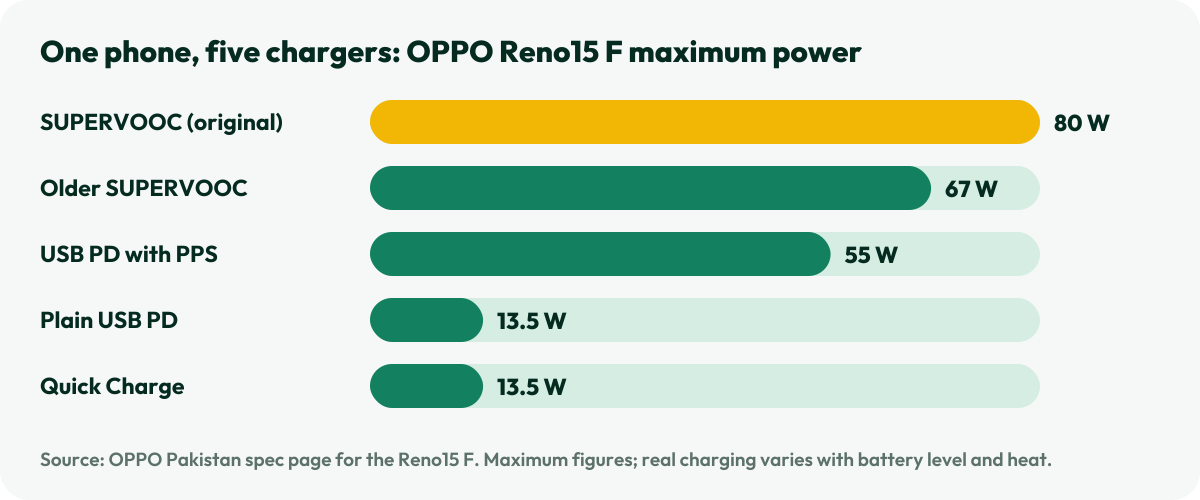
An OPPO SUPERVOOC charger and cable. The Reno15 F takes 80 W on SUPERVOOC, 55 W on PPS and only 13.5 W on plain PD.
OPPO’s own charger, with a PPS charger as backup
Xiaomi (HyperCharge)
Xiaomi’s own fast-charging protocol and its 6 A cable. Models such as the 15T Pro also accept PD and PPS.
Xiaomi’s charger and the cable it came with
vivo (FlashCharge)
The official charger and cable. Some models, like the T5 5G, list the same 44 W on a PPS charger.
vivo’s charger, or PPS where the spec page says so
Infinix and Tecno
Check the spec page. Some models support USB PD 3.0; Infinix’s GT 10 Pro page asks for a PD 3.0 charger and cable.
The brand’s charger for full speed
Headline speeds are maximums from the brands’ own lab tests. Real charging slows as the battery fills or warms up, and Apple notes fast charging may not work when it is too hot or too cold. Sources: Samsung, Apple, OPPO Pakistan, Xiaomi, vivo.
Same phone, very different speeds: the charger’s protocol matters more than its watts.
Why a bigger charger is safe, but not always faster
A phone only draws what it asks for. USB-IF designs PD so that a device works correctly with a charger of its own rating or higher, and Apple phrases its advice the same way: “a 40W adapter or higher” for the iPhone 17. So a genuine 65 W laptop charger on a 25 W phone simply charges it at up to 25 W.
More watts don’t help when the protocol is wrong, though. The Reno15 F above gets 13.5 W from a plain PD charger, whatever its size. A Samsung on a charger without PPS loses Super Fast Charging, and a 45 W Samsung on an ordinary cable stops at 25 W. Match the protocol first, then the watts.
The cable is half the charger
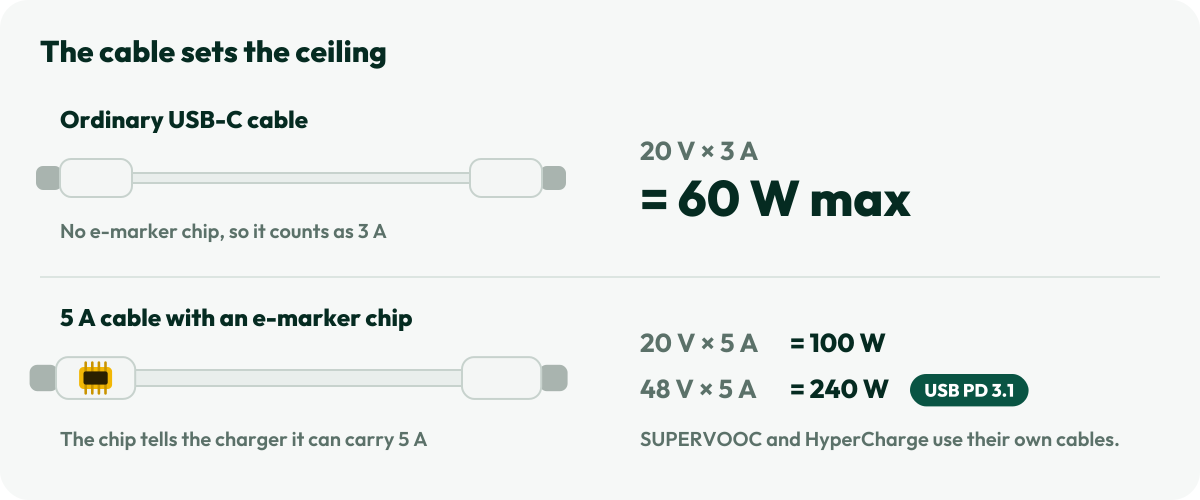
USB-C cables are not all equal. A cable without an electronic marker (e-marker) chip is treated as a 3 A cable, so at PD’s 20 V it carries at most 60 W. Going above that takes a cable rated for 5 A, and the e-marker chip is how it tells the charger so. USB-IF certified USB-C cables now carry a 60W or 240W logo.
Brand systems go their own way. Xiaomi’s HyperCharge phones come with 6 A cables, and Xiaomi says a regular or counterfeit cable won’t unlock fast charging on its 120 W charger. OPPO’s VOOC cable is USB-A to USB-C, rated 8 A, and OPPO says it needs a SUPERVOOC adapter for SUPERVOOC charging.
Above 60 W, the chip inside the cable decides whether the charger may deliver more.
Which charger should you buy?
Check your phone’s spec page for two things: its maximum wired watts and the standard it uses (PD, PPS or the brand’s own system).
Samsung: a PPS charger. Choose 45 W only if your phone is rated for 45 W, and pair it with a 5 A cable.
iPhone: a USB-C PD charger of at least the wattage in the table. A bigger PD charger is fine.
OPPO, Xiaomi, vivo, Infinix and Tecno: the brand’s own charger and cable for full speed. A PPS charger makes a good second charger if your model lists PPS support.
One charger for a phone and a laptop: a multi-port USB PD charger with PPS works, but check how its watts split when two devices are plugged in.
All our chargers and cables are brand originals, checked before dispatch. Not sure which one fits? Ask us with your phone’s model name.
Frequently asked questions
Will a 65 W laptop charger damage my phone?
Not if it is a genuine USB PD charger. The phone requests only what it can take, and without an agreement the charger stays at 5 V. The real risk is cheap, unbranded chargers with poor insulation, not the wattage.
Why does my Samsung show “Charging” instead of “Super fast charging”?
Check three things: the charger supports PPS, the cable is up to the job (5 A for 45 W), and fast charging is switched on. Samsung’s path is Settings > Battery > Charging settings > Fast charging, and it can’t be changed while the phone is charging.
Can I use an old SUPERVOOC charger with a new OPPO?
Usually, yes. The Reno15 F, for example, lists compatibility with SUPERVOOC chargers of 67 W and below, so it charges at up to the older charger’s rating.
Do I need a 5 A cable for a 25 W phone?
No. 25 W fits comfortably within an ordinary 3 A USB-C cable. A 5 A e-marked cable matters for 45 W Samsung phones and anything above 60 W.
About Mobile Sahab
MobileSahab is an online phone store in Lahore that sells only new, box-packed, PTA-approved phones and genuine accessories. Our guides come from what we check every day before dispatch: IMEIs on PTA’s DIRBS system, seals and warranty cards, and chargers and cables we test ourselves.
The mAh on the box is counted at 3.7 V, not at the 5 V your phone gets. Here is the real arithmetic, plus fast-charge support, safety and the 2026 rules for flying.
A shop’s stamp and a brand’s warranty are different promises. Here is what each covers, where to check a phone’s warranty on the brand’s own site, and how to claim.