Power bank buying guide for Pakistan: real capacity, fast charging and flight rules
The mAh on the box is counted at 3.7 V, not at the 5 V your phone gets. Here is the real arithmetic, plus fast-charge support, safety and the 2026 rules for flying.
Mobile Sahab · 7 min read
Load-shedding, a long bus ride, a full day at a wedding: a good power bank earns its place in every Pakistani bag. But the big number on the box, 10,000 or 20,000 mAh, is not what reaches your phone. This guide does the real arithmetic with a manufacturer’s own spec sheet, then covers fast-charge support, ports, safety marks and the 2026 flight rules. Box ka number nahi, Wh dekh ke lo.
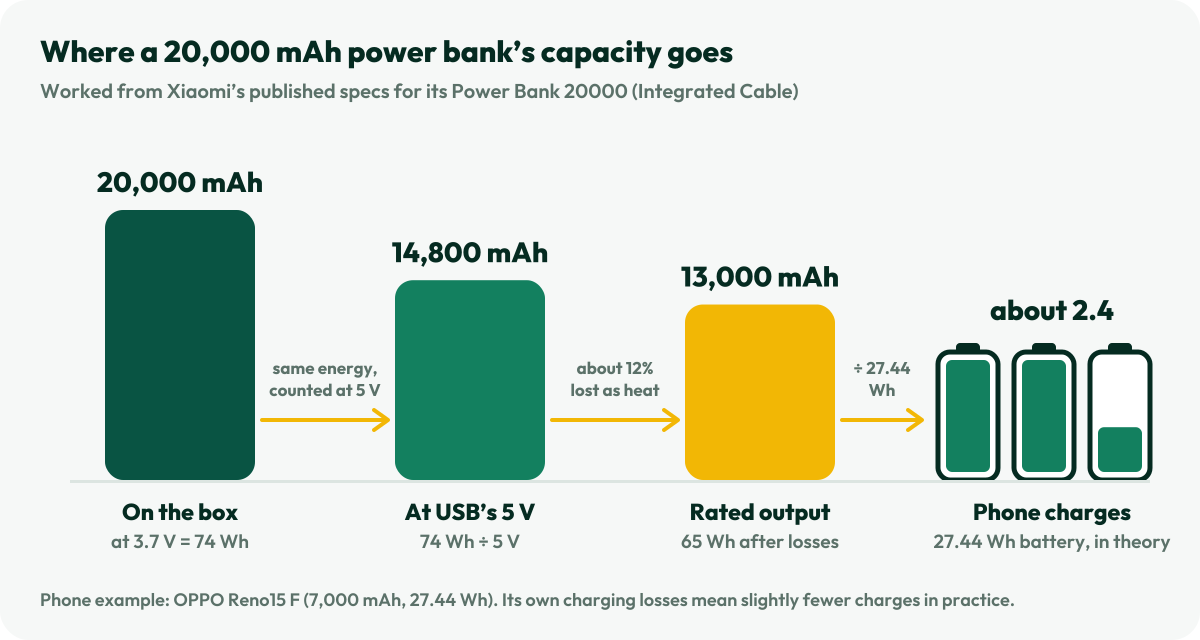
Same 74 Wh, smaller number at 5 V, then real conversion losses. That is the gap between the box and your phone.
mAh vs Wh: which number matters
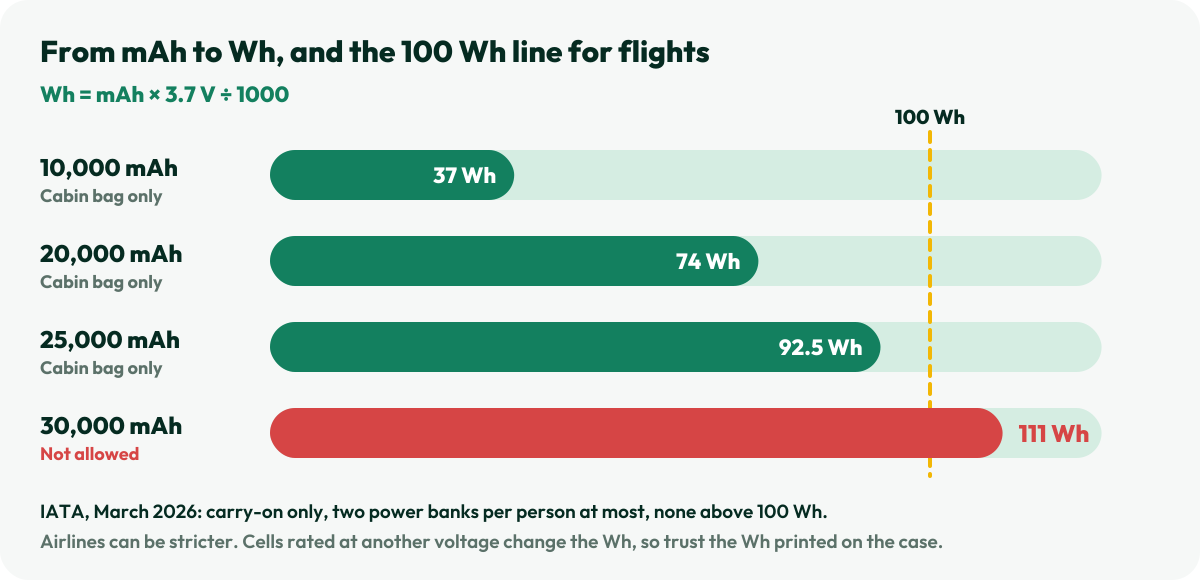
mAh measures charge at a particular voltage; Wh measures energy, which is what actually moves from the power bank into your phone. IATA gives the formula plainly: Wh = Ah × V. Power bank cells are usually rated at about 3.7 V, so:
10,000 mAh × 3.7 V = 37 Wh
20,000 mAh × 3.7 V = 74 Wh
Phones can be measured the same way: OPPO lists the Reno15 F battery as 7,000 mAh and 27.44 Wh. Comparing Wh with Wh is the honest way to estimate how many charges you will get.
Rated vs usable capacity: the arithmetic
Xiaomi publishes both numbers for its Power Bank 20000 (Integrated Cable): a cell capacity of 20,000 mAh at 3.7 V (74 Wh) and a rated capacity of 13,000 mAh at 5 V. Here is where the difference goes:
Stored: 20,000 mAh × 3.7 V = 74 Wh.
Counted at USB’s 5 V: 74 Wh ÷ 5 V = 14,800 mAh. Nothing is lost yet; the same energy just looks smaller at a higher voltage.
Conversion losses: raising 3.7 V to 5 V and above wastes some energy as heat. Xiaomi’s 13,000 mAh at 5 V is 65 Wh, about 88% of what is stored. Anker’s support team uses about 82% in its own worked example, which turns a 10,000 mAh bank into roughly 6,068 mAh at 5 V.
Into the phone: 65 Wh ÷ 27.44 Wh = about 2.4 full charges of a Reno15 F, in theory. The phone’s own charging circuit loses a little more, so plan on slightly fewer.
In these two official examples, the rated 5 V capacity is about 61 to 65% of the number on the box. Compare power banks on rated capacity or Wh, not the headline mAh.
On the box (at 3.7 V)
Energy
At 5 V, before losses
Flights (IATA 2026)
10,000 mAh
37 Wh
7,400 mAh
Cabin bag only
20,000 mAh
74 Wh
14,800 mAh
Cabin bag only
25,000 mAh
92.5 Wh
18,500 mAh
Cabin bag only
30,000 mAh
111 Wh
22,200 mAh
Not allowed (over 100 Wh)
Fast charging from a power bank
A power bank is a charger with a battery, so the rules from our fast charging guide apply: it only fast-charges if its output speaks your phone’s language.
Samsung needs PPS. Samsung’s own 20,000 mAh 45 W pack lists PD 3.0 with PPS, and gives 45 W only when a single device is connected.
iPhone needs USB PD, ideally from a USB-C port.
OPPO, Xiaomi and vivo reach their headline speeds on their own chargers. From a generic power bank they charge at the PD or PPS speed their spec page lists.
Several devices at once often means slower charging: Xiaomi’s 20,000 mAh bank gives up to 22.5 W from one port, but drops to 5 V at 3 A when more than one port is in use.
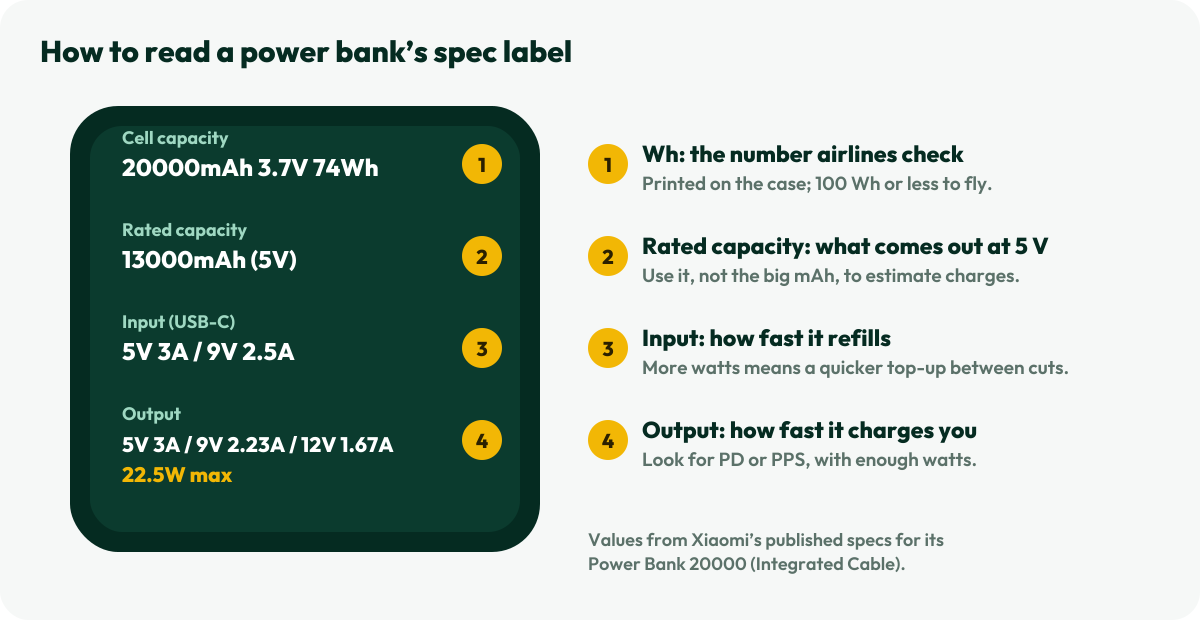
Input speed matters in Pakistan. Between load-shedding slots you may only get a few hours of power, so check how fast the bank refills. Xiaomi’s model takes up to 9 V at 2.5 A (22.5 W) over USB-C. Even in theory, 74 Wh at 22.5 W takes more than three hours; at 10 W it would take more than seven.
The four lines that matter on any power bank label, shown with Xiaomi’s published values.
Ports and features worth paying for
USB-C in and out with PD: one cable type for everything, and the fastest refill.
A USB-A port if you still use older cables.
A built-in cable, so there is one less thing to forget.
Low-current mode for earbuds and smartwatches. Xiaomi’s bank, for example, has a double-press mode that charges small devices for two hours.
Wireless (magnetic) power banks are handy, but IATA’s 2026 guidance singles them out as easy to counterfeit, with passengers reporting some going into thermal runaway. Buy them only from known brands.
Safety marks and protections
Wh on the case. IATA requires every lithium-ion battery to show its Wh rating on the outside, and airline staff can refuse one they can’t verify.
UN 38.3. Batteries that passengers carry must be of a type that passed the UN 38.3 transport tests.
UL 2056 is UL’s dedicated power bank standard, written to reduce the risk of fire or explosion; IEC 62133-2 covers the lithium cells inside.
Protections in the manual: over-charge, over-discharge, short-circuit and temperature protection. Xiaomi lists all of these for its 20,000 mAh model.
CE and similar marks help, but they are easy to copy. Our guide to fake chargers explains why.
Power banks and load-shedding: everyday safety
Charge it while the power is on, and stay nearby. Xiaomi’s manual says not to leave a power bank unattended while it charges or while it charges another device.
Mind the heat. Xiaomi gives an operating range of 5 to 35 °C. Pakistani summers pass that easily, and a parked car gets hotter still, so keep it out of the sun.
Storing it? Keep it at about 25 to 50% if you won’t use it for a while. Xiaomi says storing it full or empty shortens battery life.
Swollen, very hot or smelling odd? Stop using it and recycle it as e-waste.
Running a Wi-Fi router? Only with a power bank that lists your router’s exact voltage (check the router adapter’s label, for example 12 V) and a converter cable made for that voltage. A mismatch can damage the router.
Flying with a power bank: the 2026 rules
On 27 March 2026, ICAO added new power bank rules, and IATA’s updated passenger guidance sums them up:
Cabin bag only, never checked luggage.
At most two power banks per person, each 100 Wh or less. Power banks above 100 Wh are not allowed.
No recharging from the aircraft’s power, and keep it out of the overhead locker.
Airlines can be stricter. Emirates has banned using power banks on board since 1 October 2025 and allows one per passenger, under 100 Wh. PIA’s check-in page says spare lithium batteries and power packs are not accepted in checked baggage. Check your airline’s page before you pack.
Under 100 Wh flies in your cabin bag; 30,000 mAh banks usually don’t.
Frequently asked questions
How many times will a 10,000 mAh power bank charge my phone?
About once for a big-battery phone. Anker’s example gives roughly 6,068 mAh at 5 V, around 30 Wh, so a 27.44 Wh phone like the Reno15 F gets about one full charge. Divide the bank’s rated Wh by your phone battery’s Wh for your own number.
Can I take a 20,000 mAh power bank on a plane?
Under IATA’s 2026 guidance, yes, in your cabin bag: at 3.7 V it is 74 Wh, under the 100 Wh limit. Never in checked luggage, and some airlines won’t let you use it on board.
Is a bigger power bank always better?
Not always. A 20,000 mAh bank is heavier (Xiaomi’s weighs 342 g) and takes longer to refill. For a day out, 10,000 mAh is usually plenty; for long load-shedding or travel, 20,000 mAh makes more sense.
About Mobile Sahab
MobileSahab is an online phone store in Lahore that sells only new, box-packed, PTA-approved phones and genuine accessories. Our guides come from what we check every day before dispatch: IMEIs on PTA’s DIRBS system, seals and warranty cards, and chargers and cables we test ourselves.
A 65 W charger can still charge your phone at a crawl. Here is how PD, PPS and the brand systems really work, and which charger and cable your phone needs.
A shop’s stamp and a brand’s warranty are different promises. Here is what each covers, where to check a phone’s warranty on the brand’s own site, and how to claim.